
About the Book
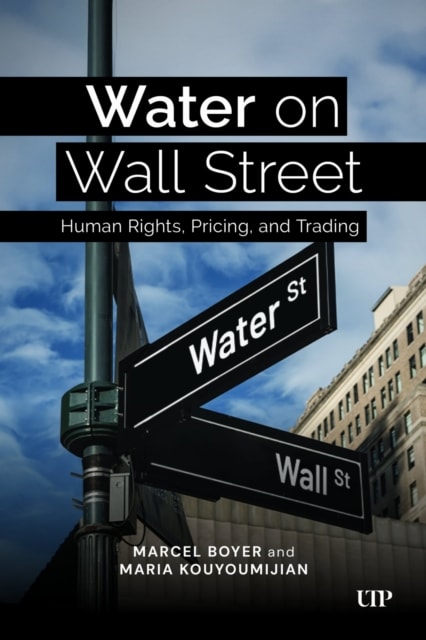
Water on Wall Street
Human Rights, Pricing, and Trading
The Origin Story
How this book came to be
Water on Wall Street began with a simple but urgent question: why, in a world of sophisticated financial markets, do we still manage water as though scarcity does not exist?
Marcel Boyer and Maria Kouyoumijian brought together decades of expertise in economics, finance, and water engineering to tackle one of the defining challenges of our century. Their collaboration grew from a shared conviction that the tools of financial markets — properly designed and carefully governed — could be part of the solution rather than part of the problem.
The result is a book that is neither a polemic nor a manifesto, but a rigorous, accessible examination of how water rights, pricing, and trading can work together to ensure fair and sustainable access for people and communities around the world.
“Water is a human right. It is also a scarce resource. These two facts are not in conflict — but pretending the second does not exist makes the first impossible to guarantee.”
The Core Argument
Markets and human rights are not opposites
Water on Wall Street explores the growing global challenge of water scarcity and access. The book examines how water rights, markets, and economic policies can work together to manage this vital resource while ensuring fair and sustainable access for people and communities.
The authors argue that well-designed water markets, transparent pricing, and clear property rights are not threats to the human right to water — they are among the most powerful tools we have to protect it. Ignoring price signals and market mechanisms has, in many cases, accelerated the very crises they were meant to prevent.
Drawing on case studies from across the globe, the book charts a path between two failed extremes: the fiction that water is free, and the fear that markets will inevitably commodify it beyond reach.
Reviews
What experts are saying
Water on Wall Street confronts one of the defining governance and sustainability challenges of our century: how societies value, govern, and safeguard water under accelerating climatic, geopolitical, and societal pressures. Marcel Boyer and Maria Kouyoumijian deliver a bold and intellectually compelling work that moves beyond ideological narratives to offer a rare integration of human rights, economics, policy, and environmental stewardship. Provocative, timely, and deeply relevant, this book should become essential reading for policymakers, regulators, industry leaders, and researchers shaping the future of global water resilience and sustainability.
Water is a human right and one of the world's most mispriced resources. In Water on Wall Street, Marcel Boyer and Maria Kouyoumijian cut through a debate too often frozen between activists who reject markets and economists who often ignore ethics. Their provocative case: the surest way to protect water is to price it and trade it, conserving supplies, ensuring access for all, and turning conflict into cooperation. Rigorous yet accessible, it is ultimately a hopeful blueprint for water security in the twenty-first century.
Powerful. Investment in the development of robust institutional arrangements — not rigid promises — is the way to ensure water security. Water on Wall Street reveals how the development of robust institutional arrangements and market mechanisms can be used to expedite progress towards global water security — before system collapse.
Boyer and Kouyoumijian make a strong case that pricing and market incentives are essential for managing economic water. Collective water — the water we need for human rights and ecosystems — requires the kind of collective governance Ostrom championed. I'd also note that out-of-basin transfers create more problems than they solve and block-rate pricing must be per capita.
A Note from the Authors
Why we wrote this book
We wrote Water on Wall Street because we believe the conversation about water has been trapped between two camps for too long: those who treat it purely as a commodity, and those who refuse to engage with economics at all. Neither position serves the billions of people who need clean, reliable, affordable water. We hope this book opens a more productive conversation — one grounded in evidence, guided by values, and oriented towards solutions.
— Marcel Boyer & Maria Kouyoumijian